
The 3-Layer Automation Framework Every Startup Founder Needs to Stop Burning Out

I remember the night like it was yesterday. My inbox was overflowing. Slack pings never stopped. I had a dozen unread customer messages, and a roadmap that looked more like a wish list. I felt like I was running in circles—working all the hours in the world but getting nowhere.
That’s when I realized the problem wasn’t the work. It was how I was handling it. I was trying to do everything myself, manually, and it was choking my time and my focus. That’s when I built what I now call the 3-Layer Automation Framework, a system that helped me reclaim my day, focus on strategic work, and actually grow my Wolfpent.com without burning out.
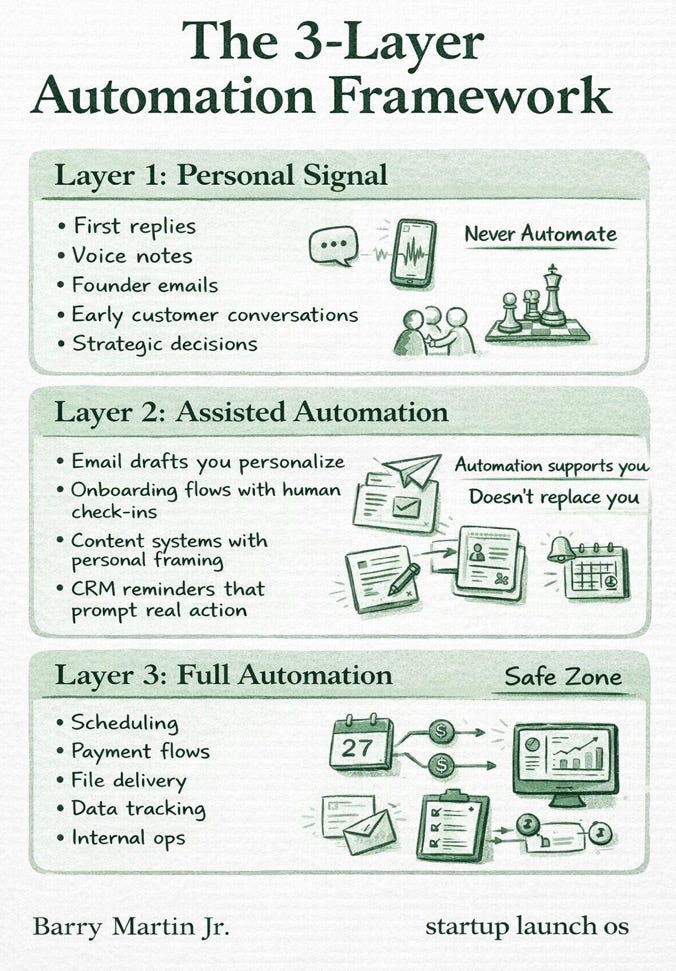
Layer 1: Personal Signal – The Work Only You Can Do
Every founder knows this feeling: some tasks demand your voice, your judgment, your touch. These are high-value moments that define your business.
First replies to early adopters
Voice notes to investors or teammates
Founder emails that set the tone
Early customer conversations that shape the product
Strategic decisions that steer the company
This layer is sacred. Never automate these. If you try, you lose context, nuance, and connection. The risk of handing this over to AI or junior staff is huge. Your intuition, experience, and gut feel are irreplaceable here.
Think of it like this: Layer 1 is your compass. If you let it go, you lose direction.
Layer 2: Assisted Automation – Let Technology Support You, Not Replace You
Once I realized what I shouldn’t automate, I needed a way to manage everything else without losing control. That’s where Layer 2 comes in: assisted automation.
Here, automation isn’t doing the work alone, it’s helping you do it better. Think of it as a co-pilot rather than a driver.
Examples include:
Email drafts you personalize: Templates that save time but still sound like you.
Onboarding flows with human check-ins: Automate the steps but never lose the personal touch.
Content systems with personal framing: Batch content production but keep your unique voice.
CRM reminders that actually prompt action: Automation nudges you when it matters, instead of just pinging endlessly.
The key principle? Automation supports you; it doesn’t replace you. It allows you to scale your influence, respond faster, and maintain high-quality interactions without being stretched thin.
For instance, one founder I worked with had a 10-step onboarding email sequence for new users. By automating the sequence but adding a human touch at key moments, she doubled engagement without sending a single extra email herself. That’s Layer 2 in action.
Layer 3: Full Automation – Let the Machine Run Routine Work
Finally, there’s Layer 3: tasks that don’t need your input at all. These are the nuts-and-bolts processes that must happen reliably but don’t require nuance.
Scheduling: Calendars and meetings handled automatically.
Payment flows: Customers pay, invoices are issued, confirmations sent.
File delivery: Reports, product files, or assets distributed automatically.
Data tracking: Metrics, dashboards, and reports updating without manual intervention.
Internal ops: HR, finance, or repetitive operational workflows running in the background.
Layer 3 is about trust. Once set up, you don’t have to think about it. Your team and systems handle these processes, freeing you for Layer 1 and Layer 2 work that actually grows your business.
Why Most Founders Get Stuck
Most startup founders spend too much time in Layer 1, thinking they’re being productive. They answer every email, join every meeting, and micromanage every detail. Meanwhile, Layer 2 and Layer 3 opportunities sit idle.
Others jump straight to Layer 3, automating everything they can, including decisions that require human judgment. That’s how you end up with a disengaged team, frustrated customers, and a product that feels hollow.
The truth is simple: you need all three layers working in harmony.
Layer 1: Protect your high-value, personal work.
Layer 2: Use automation to support and amplify your efforts.
Layer 3: Automate the routine so nothing slips through the cracks.
When each layer is properly implemented, your productivity multiplies, your team performs better, and your startup grows faster—all without burning you out.
case study
Take Alex, a founder of a SaaS startup. Before applying the 3-Layer framework, she was replying to every support email, personally sending invoices, and writing every onboarding email. Her week looked like a blur of tasks with zero focus on product strategy.
We mapped her work into the three layers:
Layer 1: She retained all early customer interviews and investor calls.
Layer 2: Onboarding emails were automated with strategic human check-ins. Templates allowed her to personalize quickly without rewriting everything. CRM reminders nudged her to follow up only when needed.
Layer 3: Payments, file deliveries, scheduling, and internal reporting were fully automated.
Result? Within six weeks, Alex reclaimed 15 hours a week, doubled customer onboarding efficiency, and finally had time to focus on product innovation.
The Lesson for Founders
Here’s the bottom line: if your day is filled with work that only you think you can do, you’re stuck. The solution isn’t doing more, it’s organizing your work across three layers.
Protect your personal signal.
Use assisted automation to scale influence.
Automate routine tasks completely.
The framework isn’t theoretical. It’s practical, repeatable, and actionable. It’s how high-performing founders survive and thrive.
Next Step: Implement This Today
Audit Your Work: List every task you do. Identify what belongs in Layer 1, 2, and 3.
Automate Wisely: Layer 2 should always involve a human check-in. Layer 3 can run entirely without your input.
Protect Your Time: Block dedicated Layer 1 hours for high-value tasks.
If you want a step-by-step system to implement this framework in your startup, you don’t have to figure it out alone.
👉 Join the Startup Launch OS Toolkit waitlist and get the tools, templates, and frameworks I use with founders to reclaim their time, scale smarter, and grow faster.
Final words
Stop reacting. Start focusing. Let the framework do the heavy lifting so you can do the work that truly matters.